
SaaS Is Dead, Long Live SofA
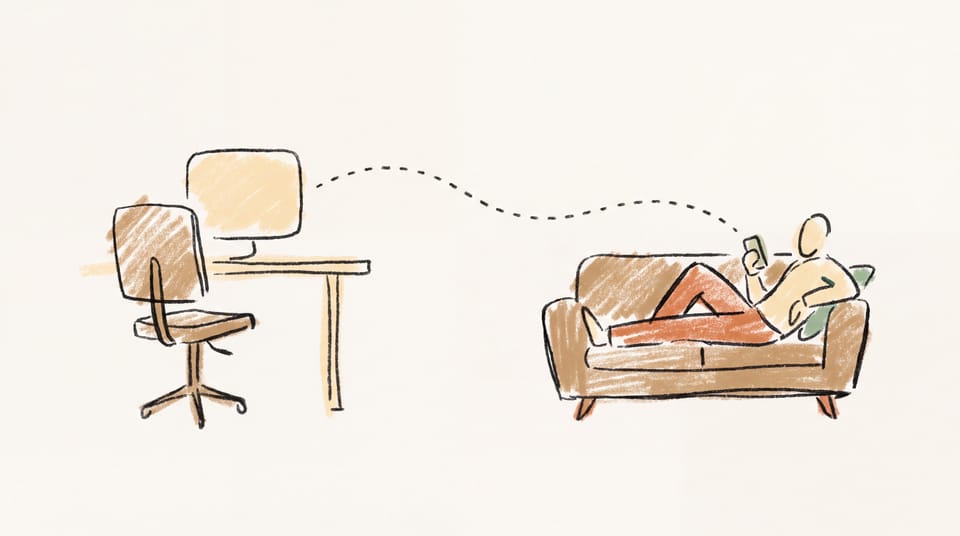
People keep saying SaaS is dead. It's alive, and its user is being replaced. For twenty years we sold software as a service to people sitting at desks. More and more, the one who logs in is an AI agent, and the person has moved to the sofa. I call what comes next SofA: Software for Agents.
I should declare an interest. I build small software products, mostly with coding agents, so I'd quite like this to be true. I've tried to keep the numbers honest anyway.
Updated November 12, 2026: first published.
The short answer
- SaaS is alive. The part in trouble is per-seat SaaS built only for humans.
- The big change is the user. Agents now open accounts, call APIs and do the work people used to click through.
- SofA, Software for Agents, is software whose first user is an agent, with a small human interface for supervising, approving and paying.
- The human stays in the picture and moves from the desk to the sofa. Done properly, that's a promotion.
Is SaaS really dead?
No. The software is alive, and most of the spending is staying where it is.
The obituary was written in February. Forrester's analysts opened a post on February 11, 2026 with this: "In seven days, over $1 trillion in market capitalization was erased from software stocks." The post was titled "SaaS As We Know It Is Dead", and the words "as we know it" were carrying most of the weight.
The calmer numbers came later. Gartner's George Brocklehurst told CIO.com on July 2, 2026 that agentic AI is "placing up to $234 billion in application software spending at risk by 2030", which the article puts at about 20% of enterprise SaaS spending. Turn that around: by Gartner's own estimate, roughly four fifths is safe. IDC's Bo Lykkegaard had already said it more plainly in December 2025: "SaaS is not dead, but it is metamorphosing."
Even the panic has cooled. US searches for "saas is dead" peaked at 2,900 a month in May 2026 and were down to 260 by August, according to DataForSEO's keyword data (pulled November 12, 2026).
So why the title? Because "the king is dead, long live the king" was never an obituary. It was said in one breath so the throne was never empty. The crown stays and the head under it changes. That's what is happening to software: the product survives, and somebody new is using it.
Why is SaaS in trouble?
SaaS is in trouble because it charges per human, and the humans are logging in less.
A seat is a person with a password. That was a fine unit for twenty years. Then agents started doing the clicking. Forrester again, in the same post: "SaaS vendor contracts are primarily based on seats. This will shift to consumption (and even outcome-based) pricing as AI agents are deployed." IDC goes further and predicts that "by 2028, pure seat-based pricing will be obsolete" (IDC FutureScape, October 2025, quoted in the December post).
The other side deserves a hearing. Box CEO Aaron Levie told Computerworld on May 28, 2026: "We think the seat model will be quite durable over time." In the same interview he said: "AI is going to be the biggest consumer and user of software going forward." Both can be true. People keep their seats, and agents arrive through the API on a meter.
I've made this switch as a buyer. At Creasoup, my agency, we replaced SocialPilot with Mixpost, which has agent and MCP integration. Notice how I described the replacement: by what an agent can do with it.
The second problem is where the thinking happens. In December 2024 Satya Nadella told the BG2 podcast that business applications would "collapse" in the agent era. CX Today's report from December 23, 2024 quotes his reasoning: agents are "going to update multiple databases, and all the logic will be in the AI tier, so to speak." If the logic moves up into the agent, the app underneath turns into a database with a nice logo. IDC has a word for that fate, "featureware", with "the agent capturing the user relationship, the workflow, and, eventually, the budget" (IDC, June 18, 2026).
What is replacing SaaS?
Software for Agents is replacing it. SofA, for short.
Here is the definition I'm working with:
SofA (Software for Agents) is software whose primary user is an AI agent acting for a person. Everything it does can be done without a screen, and the human interface shrinks to what a person needs to supervise, approve and pay.
A confession about the name: the phrase isn't mine. "Software for Agents" is a category in Y Combinator's Summer 2026 Requests for Startups, as The Next Web reported on May 2, 2026. YC's own post of April 27, 2026, which names Aaron Epstein, reads: "The next trillion users on the internet won't be people. They'll be AI agents, and they're already doing real work on top of software that was designed for humans clicking buttons."
The idea has other names too. Mathias Biilmann of Netlify named the design side of it agent experience, or AX, back in January 2025: "the holistic experience AI agents will have as the user of a product or platform." Levie calls the architecture headless software. Darius Monsef wrote about Software as an Agent in April 2026.
What I'm adding is four letters and a piece of furniture. And yes, I can spell. "Software for Agents" should abbreviate to SfA, which sounds like a regional football association. SofA borrows its first three letters from "Software", and I'm keeping it because the acronym tells you two things at once. The software is for agents. The sofa is for you.
One warning if you go searching. Google currently thinks "software for agents" means CRM tools for estate agents and call centres. Estate agents, your software is fine. This post is about a different kind of agent.
| SaaS | SofA | |
|---|---|---|
| First user | A person at a desk | An agent acting for a person |
| Interface | Dashboard in a browser | API, MCP tool, CLI command |
| Onboarding | Product tour and tooltips | Documentation a machine can parse |
| Pricing unit | The seat | Usage or outcome |
| When something breaks | A red banner | An error that says what to try next |
| Where the human sits | In the chair | On the sofa |
What does software for agents look like?
It looks like a product you never have to open.
Two examples, both from companies with more to lose than me.
Salesforce built the dashboard era. On April 15, 2026 it announced Headless 360 under the headline "No Browser Required". The announcement says: "Everything on Salesforce is now an API, MCP tool, or CLI command, and agents can use all of it." Co-founder Parker Harris asked the question out loud: "Why should you ever log into Salesforce again?" When the company that taught the world to log in asks why you would, something has moved.
Neon, the Postgres company, saw it in its own sign-ups. When Databricks announced it was buying Neon on May 14, 2025, its founders wrote that when Neon launched, "30% of the databases were created by AI agents, not humans", and that when Neon looked again "the number went from 30% to over 80%". That's the vendor's own figure, so treat it as theirs. Still, four out of five customers at the door were software.
From those two, and from building my own things, this is my working checklist for a SofA product:
- Every button is also a call. If a person can do it in the interface, an agent can do it through an API, an MCP tool or a command line. (MCP is the Model Context Protocol, the common way agents plug into outside tools.)
- The documentation is the onboarding. No tour, no tooltip. I wrote about the reading half of this in Agent First: say the answer first, name the numbers, keep one source of truth.
- Errors give directions. "Something went wrong" stops an agent dead. "Rate limit reached, retry in 30 seconds" lets it carry on.
- Permission is borrowed and limited. The agent acts for someone. The product should know for whom, and what that person allowed.
- The price fits a customer that never sleeps. An agent might call you twice or two million times. A seat can't describe that. A meter can.
- There's a view from the sofa. What did it do, what did it spend, what needs my yes. That is the human interface now.
I have a small version of this at work. At Game Set Engage, a fan engagement platform for sports clubs, there is an AI agent whose only job is to check every claim we publish against the code. It's a colleague with no chair. And Game Set Engage has an MCP server, which is our own agent door.
Where does the human go?
To the sofa. Officially, now.
Anthropic's documentation for Claude Code's Remote Control feature describes it like this: "Start a task at your desk, then pick it up from your phone on the couch or a browser on another computer" (Claude Code docs, checked November 12, 2026). When the manual mentions the couch, the couch is part of the workflow.
Developers got there first. For decades the job meant sitting upright at a desk with both hands on a keyboard, because the computer needed you for every line. Now you can hand an agent a task, lie down, and steer it from your phone with one thumb. Posture and productivity have finally been separated. Your physiotherapist may have views.
I arrived early, by accident. In January I wrote about building a SaaS while I slept. I wrote the requirements with Claude in the evening, handed the task list to an autonomous loop called Ralph, and went to bed at 11 PM. Ralph ran Claude Code for about five hours. In the morning there was a working app: Poromopot, a prompt management platform for teams.
The part people skip: I then spent about two hours fixing buttons that looked wrong. A sofa is for sitting on, and you're expected to stay awake.
So what does the person on the sofa do? Decides what is worth building. Says yes or no at the moments that cost money or can't be undone. Notices when the output is correct and still wrong. Takes the blame. None of that needs a desk, and all of it needs judgment. It's why I keep saying the webmaster is back, and why very small companies can now do work that used to need a whole floor.
The rest of the company is following the developers. Among organizations with 500 or more employees, 74% had already deployed at least one agent, according to IDC's April 2026 Future Enterprise Resiliency and Spending survey (reported by IDC on June 18, 2026, sample size not given).
What should a SaaS founder do now?
Find out who your user is this year, then build that user a door.
- Look at who's logging in. Check your traffic and your API logs for agents. You may already have users you never designed for.
- Turn your buttons into calls. Start with the five actions your customers do most.
- Publish what an agent needs to pick you. Prices, limits, what you don't do. An agent comparing three vendors skips the one that says "contact us".
- Add a price a machine can pay. Keep seats for people and add a meter for agents. Levie's version, from the same Computerworld interview: agent-only use "will be primarily coming through the API, and then that will be a consumption model."
- Design the sofa view. Approvals, a log, an undo. Small screen, big buttons.
And be honest about where this stops. Software that holds the record of something (money, patients, contracts) is in a strong position, because agents need somewhere trustworthy to read from and write to. IDC's June post puts it this way: "A SaaS vendor can offer vetted business processes, governed data, and audit trails for custom AI agent consumption." SofA leaves those companies standing. It changes who is at their front door.
Want to compare notes?
If you're working out what the agent door of your own product should look like, find me on LinkedIn. I'll be on the sofa.
Frequently asked questions
Did Satya Nadella say SaaS is dead?
Not in those words, as far as the reporting shows. On the BG2 podcast in December 2024 he said business applications would "collapse" in the agent era, with "all the logic" moving to "the AI tier", according to CX Today's report of December 23, 2024. The three-word version spread afterwards, and even IDC's own blog attributes it to him.
What does SofA stand for?
SofA stands for Software for Agents: software whose primary user is an AI agent acting for a person, with a small human interface for supervising, approving and paying. Y Combinator used the phrase "Software for Agents" in April 2026. The abbreviation is mine, and the pun on the sofa, where the human now sits, is deliberate.
Will AI really replace SaaS?
AI is more likely to change who uses SaaS than to replace it. Gartner estimates that up to $234 billion in application software spending is at risk by 2030, about 20% of enterprise SaaS spending (CIO.com, July 2, 2026). Most products stay. The exposed ones were built only for a person clicking through a browser.
Does SaaS have a future?
Yes. IDC's verdict in December 2025 was "SaaS is not dead, but it is metamorphosing." Products that hold important records, such as money or contracts, are well placed, because agents need a trusted place to read from and write to. The future version sells access to agents as well as seats to people.
Is SofA the same as headless SaaS or agent experience (AX)?
They overlap. Headless SaaS describes the architecture: the product works through APIs without its own screen. Agent experience (AX), a term from Netlify's Mathias Biilmann in January 2025, describes the design discipline. SofA is my name for the whole product category, including pricing, permissions and the small interface left for the human.