
Best Before
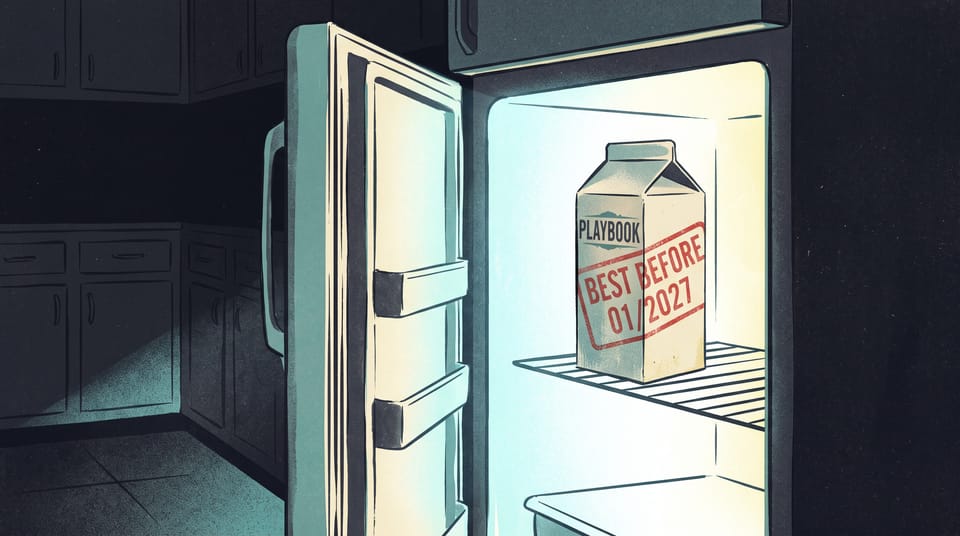
Every carton of milk in my fridge tells me exactly when to stop trusting it.
Almost no AI playbook does.
A post went past me on X this week that I haven't been able to shake. Its point: the gap between people working at the frontier of AI and everyone else isn't closing. It's getting wider. If you wrote down your AI processes three to six months ago, you're probably behind again. If you did it a year ago and called it done, you're further behind than that.
I think that's right. I'd just add one thing. The problem isn't that people are slow. It's that the way we catch up with new technology was built for technologies that stood still long enough to be caught.
Technology used to wait for us
Every big technology of the last few decades had the same shape. A burst of chaos, a few years of experiments, then a long flat stretch where everyone else could arrive.
In the late 1990s the web was chaos, and browsers agreed on almost nothing. A decade later there were standards, frameworks and agencies that could build you a decent site from a checklist.
Mobile went the same way. The iPhone arrived in 2007, Ethan Marcotte gave us responsive web design in 2010, and a few years later "make it work on phones" was a line item, not a strategy.
That flat stretch is where best practice comes from. Consultants write the playbook, companies roll it out, and the competitive advantage quietly evaporates because everyone is doing the same thing. Arriving late cost you a little, but you got a tested, cheaper, standardized version in exchange. Waiting was a perfectly reasonable strategy.
This one doesn't level off
AI hasn't given us that flat stretch. Not yet, anyway.
METR, a research group that tests AI agents, measures progress in a refreshingly human unit: how long a task, timed on a skilled person, an AI can finish on its own about half the time. GPT-4, in March 2023, managed tasks of around four minutes. Claude 3.7 Sonnet, in February 2025, about an hour. By April 2026, the best model was likely past 16 hours, which is roughly where METR says its current tasks stop measuring reliably.
METR's original paper put the doubling time at around seven months. Its January 2026 update found progress since 2023 running faster, doubling roughly every four months. These are software tasks on a benchmark, not every job in your company, and twice the horizon isn't twice the automation. But the direction isn't in question.
Now put that next to how companies adopt things. In 2025, MIT's Project NANDA found 95% of the organizations it studied getting no measurable return from generative AI, despite $30–40 billion in enterprise spending. You can argue with that headline; it's a preliminary study. The detail I can't stop thinking about is a smaller one: large enterprises took nine months or longer to go from pilot to full rollout. Mid-sized companies did it in about 90 days.
Nine months is more than two doublings. A big company that starts a careful rollout today will finish it on models roughly four times as capable as the ones it designed for. The process arrives already out of date. That's the widening gap, in one sentence.
Your playbook is a snapshot
Here's the part I think gets missed. When you codify an AI workflow, you aren't only writing down steps. You're writing down a list of things the model couldn't do that month.
We split the task into five prompts because it lost the thread on long ones. We added a human review step because it got the numbers wrong. We kept the agent away from the database because it wasn't reliable with tools.
Every one of those decisions was right when it was made. Every one of them is also an assumption with an expiry date, and nobody wrote the date down.
Six months later the limitation is gone, but the workaround is still there, baked into a process document, a training deck and three people's job descriptions. The company isn't using AI badly. It's using last year's AI perfectly.
This is what our brains do with change: we draw a straight line. Ask someone to plan around something that doubles every few months, and they'll quietly add a little each quarter. Organizations do the same thing, just slower, and with a steering committee.
Stamp a date on it
Milk doesn't pretend to last forever. Your AI processes shouldn't either. Instead of writing the playbook once, here's what I'd do:
- Put a best-before date on every workflow. Three months is a sensible default. When it passes, the workflow isn't deleted, but it has to earn its place again.
- Write down the why, not just the how. Next to every workaround, note the limitation it exists for: "split into steps because long tasks were unreliable." When the limitation goes, you'll know exactly what to remove.
- Keep a drawer of failures. Save the tasks AI couldn't do for you. Every time a new model ships, run them again. It's the cheapest benchmark you'll ever own, and the only one that measures your work.
- Try the ambitious version first. Before you design around a limitation, assume there isn't one and hand over the whole job. You'll be wrong sometimes. You'll be surprised more often than you expect.
- Delete as much as you add. If your AI process only ever grows, you're stacking new tools on old assumptions. Every review should remove something.
- Give your frontier people a longer leash. In most teams someone is already months ahead, often quietly, on tools nobody approved. The MIT study found workers at over 90% of companies using personal AI tools for work, while only 40% of those companies had bought an official subscription. Don't make those people wait for the policy. Have them write the next version of it.
- Budget for rebuilding, not maintaining. If a rollout takes nine months, plan the second one before the first is finished.
Milk, not marble
A playbook used to be marble: carve it once and it stands for a decade. Right now it's milk.
That isn't a reason to stop writing things down. It's a reason to write them down differently: with a date, a reason, and the expectation that you'll be back. The companies pulling ahead aren't the ones that got AI right once. They're the ones that got used to getting it right again.
Maybe the curve flattens next year and the rest of us finally catch up. I wouldn't build the plan around it.
If you'd like a second pair of eyes on how dated your AI workflows already are, find me on Linkedin.
Sources: METR time-horizon estimates (Wikipedia summary), Virtualization Review on MIT NANDA's "The GenAI Divide: State of AI in Business 2025"