
A door in your pocket
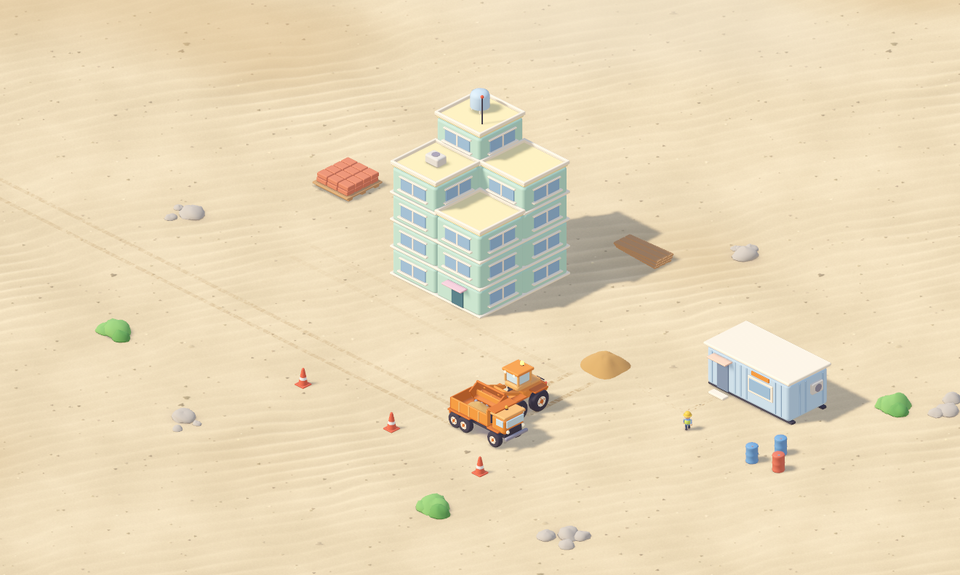
What if there was a door in your pocket that only opened for you?
That's roughly what I'm building. You open it and a tiny construction site is already busy. A crane is stacking floors. A wrecking ball is swinging at a building someone finished a minute ago. A loader scoops up the rubble, a dump truck drives it off the edge of the screen and comes back empty, and a grader flattens what's left. Off in a corner, the next building has started.
Nobody scripted any of it.
The old men at the fence
Every city has them. Retired men at the fence of a building site, hands clasped behind their backs, watching a concrete pour as if it were a cup final. In Turkey it's practically a genre. Americans used to call them sidewalk superintendents.
I used to find it funny. I think now they were onto something long before the rest of us started paying for meditation apps.
A building site asks nothing of you. It doesn't send notifications or keep a streak. A crane lowers a block, the block settles, a bit of dust comes up, and then the crane swings back for the next one. You just stand there and watch it happen.
Every time I tried to picture a good mindfulness app, I ended up back at that fence. So I'm making one.
The part I like most is where the world comes from. Everything is generated from your device and the exact moment you open the app. Those two things get boiled down into one number, a seed, and the whole site grows out of it: the darker patches in the sand, where the site office ends up, how many floors each building gets and what color it's painted, how many machines turn up for work.
Give it the same seed and you get the same world. Anything else gives you a different one, and since your phone's ID and the moment you opened it are yours alone, the site on your screen doesn't exist anywhere else. Someone else opening the app gets their own universe.
When you close it, yours is gone for good.
There's no account and it never goes online. Nothing gets saved. The site is only there while you're looking at it, which I suspect Schrödinger would have enjoyed.
It keeps your time, too. At dusk the light goes lilac. After midnight the windows are lit and the machines drive around with their headlights on. On a Mac it'll run as a screen saver, so your idle screen becomes a building site nobody else will ever see.
How it's getting built
I'm making it with Claude, and the process taught me more than I expected.
The first version was a browser prototype that came together in a single conversation. Every machine has one trade. Cranes build, wrecking cranes demolish, loaders load, trucks haul, graders level. Nobody tells them where to go. There's a job board instead. When a building has stood long enough, a small flag goes up on its roof, and the nearest idle wrecking crane claims it and works out its own route there. If something is in the way it waits, tries another route, and eventually one of them backs off.
The bugs were mostly office politics. In one test run, all eight sites on the screen got stuck in rubble at the same time. The loaders were sitting there with full buckets waiting for a truck, and the trucks were coming back from the dump, parking wherever they fancied and waiting to be given something to do. Nobody gave them anything. The fix was to let a truck take a new job while it's still driving back. I've worked in companies with the same problem.
Then I looked at the thing properly and didn't like it.
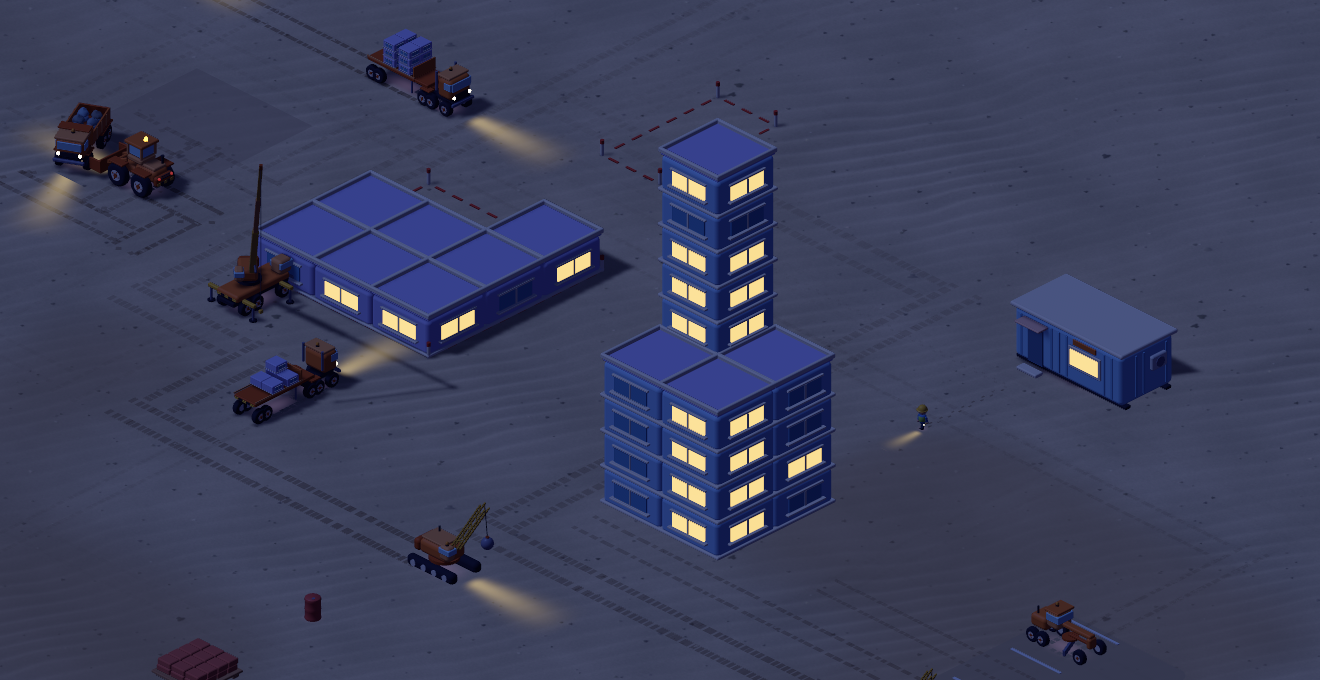
It behaved well but it looked flat and beige, closer to a technical drawing than a toy. Maybe that was the browser, maybe it was how it had been drawn. Either way I'd rather bin a picture than live with it. I kept the rules and the tuned numbers, wrote everything those trucks taught me into a spec, and now Claude Code is rebuilding it natively for iPhone and Mac in real 3D. What I'm after is a model railway sort of feeling: soft shadows, chunky toy machines, a little tilt-shift blur so it looks like you're leaning over a table.
The simulation can wait. First comes a look test, and nothing gets built at full scale until I like what I see.
Jack of some trades
I wrote my first HTML in 1998. Since then I've been a webmaster, a front-end developer, an art director and an agency founder, and these days I'm mostly orchestrating AI. I never became the best at any of it.
This app needs a bit of each of those jobs, though. Somebody has to be able to describe a wrecking ball's swing in numbers and then look at the result and say the colors are off. A few years ago that meant hiring a small team. Now it's one generalist with a decent spec, and a lot of patience for trucks.
More soon. If you'd like your own door when it's ready, drop me a line.